

WTV means “whatever” in texting and on social media. People use it to show that they are flexible, unbothered, bored, or slightly annoyed, depending on the message and the situation. It is a short slang term that can sound friendly in one chat and dismissive in another.
For example, if a friend asks, “Coffee or juice?” and you reply, “WTV, I’m good with either,” it means you do not mind. But if someone says, “You never listen to me,” and you reply only, “WTV,” it can sound cold or rude.
What Does WTV Mean?
WTV is an abbreviation for “whatever.” It is commonly used in text messages, Snapchat, Instagram, TikTok, Facebook, and online group chats. Both uppercase WTV and lowercase wtv have the same basic meaning.
The word “whatever” already carries more than one feeling. WTV keeps those feelings but makes the message shorter and more casual. It can mean:
- “I don’t have a preference.”
- “I’m okay with anything.”
- “It does not matter to me.”
- “I’m tired of discussing this.”
- “Do what you want.”
- “I’m not emotionally invested in this topic.”
In simple words, WTV is the texting version of a shrug. It can be relaxed, careless, playful, or dismissive based on context.
Read Also This Blog NK Slang Meaning
WTV Slang Meaning in Text
In texting, WTV usually replaces “whatever” at the end or middle of a sentence. It is popular because it saves time, keeps messages informal, and gives the conversation a relaxed tone.
| Message | What WTV Means |
|---|---|
| “Pizza or burgers?” “WTV” | “I’m fine with either option.” |
| “Are you coming?” “WTV, maybe later.” | “I’m not sure or not very interested.” |
| “You always do this.” “WTV.” | “I don’t want to argue.” |
| “We can leave at 7 or 8, wtv.” | “The timing is flexible.” |
| “He said something about you.” “WTV, I don’t care.” | “It does not bother me.” |
| “Should I wear blue or black?” “WTV, both look good.” | “You choose; I have no preference.” |
The same three letters can express agreement, indifference, or annoyance. That is why punctuation, emojis, and the rest of the conversation matter so much.
Why Punctuation Matters So Much
WTV can look harmless, but punctuation changes its emotional tone. A simple “wtv” may feel neutral, while “WTV.” can feel sharp, final, or passive-aggressive.
| Version | Likely Tone | Example |
|---|---|---|
| “wtv” | Casual or neutral | “Movie or show? wtv” |
| “wtv :)” | Friendly and easygoing | “We can go today or tomorrow, wtv :)” |
| “wtv lol” | Light and joking | “I’ll just wear anything, wtv lol” |
| “WTV.” | Dismissive or annoyed | “You never understand me.” “WTV.” |
| “WTV, I don’t care.” | Clearly dismissive | Often used during an argument |
| “WTV…” | Cold, tired, or passive-aggressive | “Fine. WTV…” |
A period after WTV can make the reply feel like a closed door. An emoji, on the other hand, can soften the message and show that the person is not upset.
If you want to avoid sounding rude, add a friendly word or emoji: “WTV, you choose 😊” sounds much warmer than “WTV.”
How Context Changes the Meaning of WTV
Context is everything with WTV. The abbreviation itself does not decide whether the message is polite or rude; the conversation does. The same reply can be completely normal between close friends but hurtful during a serious discussion.
Casual Acceptance
WTV often means the person is easygoing and does not mind the choice.
- “Do you want tea or coffee?” “WTV, both are fine.” ☕
- “Should we meet at 6 or 7?” “WTV, whatever works for you.” ⏰
- “Which color should I choose?” “WTV, they all look good.” 🎨
- “Should we watch a movie or a series?” “WTV, I’m free tonight.” 🎬
- “Do you want to sit inside or outside?” “WTV, either is okay.” 🪑
In these examples, WTV shows flexibility rather than anger. The person is simply saying that any option works.
Indifference
Sometimes WTV means the person genuinely does not care about the topic.
- “People are talking about your post.” “WTV.”
- “Do you want to watch the news?” “WTV, I’m not interested.”
- “Are you worried about the comments?” “WTV, I don’t pay attention to them.”
- “He said you changed.” “WTV, people will talk.”
- “Do you care if they come?” “WTV.”
Here, WTV can communicate emotional distance or a lack of interest. It does not always mean anger; sometimes it means the person has decided not to give the topic attention.
Dismissiveness
WTV can shut down a conversation, especially when it appears alone.
- “I think you should apologize.” “WTV.”
- “You’re not listening to me.” “WTV.”
- “This is important.” “WTV.”
- “I feel like you don’t value my opinion.” “WTV.”
- “Can we please talk about this properly?” “WTV.”
A standalone “WTV” can feel like, “Stop talking” or “I’m done with this conversation.” This is why it can damage communication if the other person is already upset.
Mild Annoyance
WTV may also show irritation without starting a full argument.
- “You’re late again.” “WTV, I’m here now.”
- “You forgot to reply.” “WTV, I was busy.”
- “You always say that.” “WTV.”
- “You never want to go out.” “WTV, do what you want.”
- “I told you not to do that.” “WTV.”
In these cases, the person may be frustrated but does not want to explain their feelings. The short reply creates distance without directly saying, “I’m annoyed.”
WTV Meaning on TikTok, Snapchat, Instagram, and Chats
WTV has the same core meaning across platforms: “whatever.” However, the way people use it can change slightly depending on where they are chatting and what kind of content they are posting.
Text Messages
In private texts, WTV is often used to make plans or end a discussion.
- “Dinner at 8?” “WTV, I’ll be there.”
- “Are you upset?” “WTV, I’m just tired.”
- “You pick the movie.” “WTV, I trust you.”
- “Should I call you now?” “WTV, whenever you’re free.”
- “Do you want me to pick you up?” “WTV, I can walk.”
It keeps the conversation short and informal, especially when the decision is not important.
TikTok and Instagram
On TikTok and Instagram, WTV can appear in captions, comments, Reels, Stories, and DMs. It often gives a relaxed, unbothered, humorous, or confident vibe.
- “Got ready in 10 minutes, wtv.”
- “They can talk, wtv.”
- “No plans today, just doing wtv.”
- “He said I changed, wtv.”
- “Posted this at 2 a.m., wtv.”
- “Not everyone will like me, wtv.”
In captions, WTV often signals confidence or a “I don’t care what people think” attitude. In comments, it can be playful, sarcastic, or dismissive depending on the post.
Snapchat
Snapchat users often use WTV in quick replies because the app is built around fast, casual messaging. It may mean flexibility, boredom, or a lack of interest.
- “Wanna snap later?” “WTV.”
- “Should I send it now?” “WTV, whenever.”
- “Are you coming out?” “WTV, maybe.”
- “What should I post?” “WTV, anything is fine.”
- “Do you want to talk?” “WTV, I’m free.”
Because Snapchat messages are often brief, WTV can feel more neutral there than it does in a serious text conversation.
Group Chats and Online Communities
In group chats, WTV is useful when nobody wants to make a decision.
- “Where are we meeting?” “WTV, someone decide.”
- “Are we doing the project today?” “WTV, I’m free.”
- “Who is choosing the game?” “WTV, I’ll play anything.”
- “Should we order food now?” “WTV, I’m hungry either way.”
- “Are we taking the early bus?” “WTV, I’ll manage.”
It can make the sender seem laid-back, but too many “wtv” replies may make them seem uninterested or unwilling to participate.
Real Conversation Examples
Example 1: Friends
Ali: “Should we order biryani or pizza?”
Sara: “WTV, I’m hungry.”
Ali: “Pizza it is then.” 😄
Here, WTV means “I don’t mind; you choose.” The conversation stays light because the topic is simple.
Example 2: Argument
Hina: “You never tell me anything.”
Ahmed: “WTV.”
Hina: “That’s exactly the problem.”
In this conversation, WTV sounds dismissive and may make the argument worse. A better response would be, “I’m sorry you feel that way. Can we talk about it?”
Example 3: Group Chat
Friend 1: “Beach or café tomorrow?”
Friend 2: “WTV, I’m free either way.”
Friend 3: “Let’s do the beach then.” 🌊
Here, WTV is friendly and cooperative. It helps the group move forward without unnecessary discussion.
Example 4: Social Media Caption
Caption: “New haircut, new mood, wtv.”
Comment: “You look good though 😍”
In this case, WTV adds a casual, confident tone. It suggests the person is not overthinking other people’s opinions.
Is WTV Rude?
WTV is not always rude, but it can sound rude if used alone during a serious conversation. The risk is higher when someone is explaining their feelings, making a complaint, or trying to solve a problem.
WTV is less likely to sound rude when:
- You add a friendly explanation: “WTV, I’m happy with either.”
- You use an emoji: “WTV 😊”
- The topic is small, such as food, timing, or entertainment.
- The other person knows you are joking.
- You are responding to a casual question with no emotional weight.
It is more likely to sound rude when:
- You reply only “WTV.”
- Someone is upset or emotional.
- You use it during a serious disagreement.
- Your tone is already cold or short.
- The other person has asked for a clear answer.
If you care about the person or the issue, it is better to write a full response instead of relying on WTV. Clear words reduce misunderstandings and show respect.
Is WTV Flirty?
WTV can be flirty, but only when it is paired with playful wording, teasing, or emojis. On its own, it usually sounds neutral rather than romantic.
Flirty examples include:
- “You can pick the place, wtv, I just want to see you.” 😉
- “WTV you say, I’m still thinking about you.”
- “You’re trouble, wtv, I like it.”
- “You can text me whenever, wtv, I’ll reply.”
- “WTV, you already know I like talking to you.”
Without extra context, though, “wtv” may simply mean “whatever” or “I don’t mind.” Do not assume it is flirting unless the rest of the conversation supports that idea.
How to Reply to WTV
Your reply should match the tone of the original message. If WTV sounds flexible, offer a choice. If it sounds dismissive, stay calm and ask a direct question.
Friendly Replies
- “Okay, I’ll choose then.”
- “Cool, let’s do the easiest option.”
- “Got it, I’ll text you the plan.”
- “No problem, we can decide later.”
- “I’ll pick something you like.”
- “Perfect, I’ll handle it.”
- “Sounds good, I’ll let you know.”
Funny Replies
- “WTV? That’s not a plan, that’s a vibe.”
- “Okay, mysterious one. I’ll decide.”
- “So you’re saying I’m the leader now?”
- “Fine, we’re getting snacks. No complaints later.”
- “WTV accepted. The decision has been made.”
- “Your trust in my decision-making is scary, but okay.”
- “WTV? Bold strategy. I respect it.”
When WTV Sounds Dismissive
If someone replies “WTV” during a serious conversation, avoid matching their coldness. Try:
- “I want to understand what you mean.”
- “It seems like you’re upset. Do you want to talk later?”
- “I care about this, so I’d like a real answer.”
- “If you need space, that’s okay. We can talk when you’re ready.”
- “I respect your feelings, but I’d like to solve this calmly.”
This keeps the conversation respectful without forcing an immediate response.
When to Use WTV
WTV works best in informal conversations where a short, relaxed reply is appropriate.
- Choosing food, movies, music, or meeting times.
- Responding to a minor opinion or suggestion.
- Showing that you are flexible.
- Keeping a casual conversation light.
- Adding a playful or unbothered tone to a social media caption.
- Ending a pointless argument without writing a long message.
- Replying to a friend who knows your sense of humor.
- Making a low-stakes decision where either option is fine.
It is especially common among friends, classmates, siblings, and people who already use texting slang.
When to Avoid WTV
Avoid WTV when clarity, respect, or professionalism matters.
- Job emails or messages to a manager.
- Conversations with teachers, clients, or elders.
- Serious relationship discussions.
- Apologies or emotional support.
- Customer service conversations.
- Situations where the other person may already feel ignored.
- Important family matters.
- Messages that require a clear decision.
Instead of “WTV,” try “I’m flexible,” “Either option works for me,” or “I understand, and I’d like to discuss it calmly.” These phrases sound more thoughtful and reduce misunderstanding.
Common Mistakes About WTV
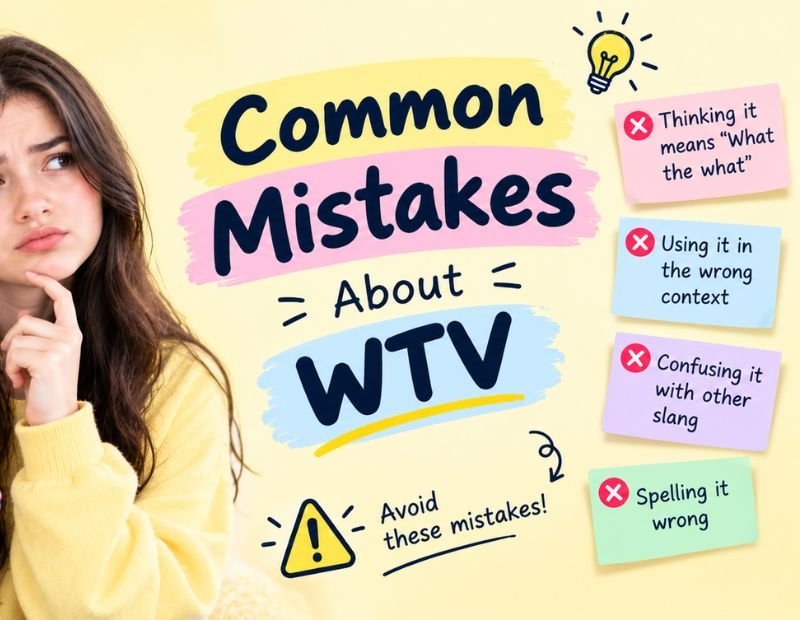
Many people misunderstand WTV because it looks simple but carries different emotions.
- Thinking WTV always means rude: It can simply mean “either is fine.”
- Using it in formal messages: It is too casual for professional communication.
- Sending it alone during conflict: This can sound dismissive.
- Assuming it has only one emotional meaning: Tone and context matter.
- Using too many slang abbreviations: It can make your message unclear.
- Ignoring punctuation: “wtv” and “WTV.” do not always feel the same.
- Using WTV when someone needs support: It can make them feel unheard.
- Assuming WTV means flirting: It usually does not unless the conversation is already playful.
The safest approach is to use WTV with friends and add context when the topic could be sensitive.
Similar Slang Terms
WTV belongs to a wider group of casual texting abbreviations. These terms often overlap, but their tones are not identical.
| Slang | Meaning | Typical Use |
|---|---|---|
| WTV | Whatever | Flexible, indifferent, or dismissive |
| IDC | I don’t care | Stronger indifference |
| IDK | I don’t know | Uncertainty |
| IMO | In my opinion | Sharing a personal view |
| TBH | To be honest | Introducing an honest opinion |
| NVM | Never mind | Taking back a question or comment |
| SMH | Shaking my head | Disappointment or frustration |
| FYI | For your information | Sharing information |
| ILY | I love you | Affection |
| BRB | Be right back | Temporary absence |
| IKR | I know, right | Agreement |
| TBF | To be fair | Adding balance to an opinion |
WTV is often softer than “IDC.” “WTV, I’m fine with either” sounds relaxed, while “IDC” can sound more direct or emotionally detached.
WTV Meaning: Quick Recap
- WTV means “whatever.”
- It is used in texts, Snapchat, Instagram, TikTok, and online chats.
- It can show flexibility, indifference, boredom, or annoyance.
- Punctuation and context strongly affect its tone.
- “WTV, you choose” is friendly; “WTV.” can sound dismissive.
- Avoid it in professional, emotional, or serious conversations.
- Add emojis or extra words if you want to sound warm rather than rude.
- WTV is not automatically flirting; it is usually just casual slang.
FAQs
What does WTV mean from a girl?
It usually means “whatever,” but the tone depends on the conversation. It can mean she is flexible, uninterested, or annoyed.
What does WTV mean from a boy?
It normally means “whatever” too. If he sends it alone during an argument, it may signal frustration or disinterest.
Does WTV mean “whatever” or “what’s the vibe”?
WTV most commonly means “whatever.” “What’s the vibe” is a much less common meaning and depends heavily on context.
Is WTV rude in texting?
It can be rude if sent alone during a serious conversation. With friendly wording or emojis, it usually sounds casual and harmless.
What should I reply when someone says WTV?
If they sound flexible, say, “Okay, I’ll choose.” If they sound upset, ask calmly, “Do you want to talk about it later?”
Is WTV the same as IDC?
No. WTV means “whatever,” while IDC means “I don’t care.” IDC often sounds more direct and emotionally detached.
Can WTV be used on Instagram?
Yes. People use it in DMs, comments, captions, Story replies, and Reels to create a casual or unbothered tone.
Is lowercase “wtv” different from uppercase “WTV”?
No, the meaning is the same. Uppercase WTV may feel slightly more intense or dismissive in some conversations.
Can WTV end a conversation?
Yes. A standalone “WTV” can signal that the person does not want to continue the topic, especially if it is sent with a period.
Is WTV appropriate for school or work?
No. It is informal slang, so it is better to use complete phrases in school assignments, work emails, and professional chats.
Conclusion
WTV is a simple texting abbreviation for “whatever,” but its real meaning depends on tone, punctuation, and context. It can make a message sound relaxed and cooperative, or it can shut down a conversation if used carelessly.
Use WTV when you want to keep casual chats short and friendly. Avoid it when someone needs a clear, respectful, or emotional response. When in doubt, write a little more: “WTV, I’m happy with whatever you choose” is much warmer than a plain “WTV.” 😊

I am a dedicated writer with over 3 years of experience researching word meanings, internet slang, abbreviations, and symbols. Through MeaningBright.com, I simplify complex meanings into clear, accurate, and easy-to-understand explanations, helping readers stay informed with reliable and engaging content.