

You’ve got an idea. Maybe it’s a new product, an event, or a proposal you want to pitch. Before you commit time, money, or energy, you want to know one thing: does anyone actually care?
That’s exactly what “gauge interest” means, and it’s one of the most useful phrases in business, marketing, and everyday planning. This guide breaks down what the phrase really means, where it comes from, and exactly how to use it correctly in your own writing and conversations.
What Does “Gauge Interest” Actually Mean?
To “gauge interest” means to measure or assess how much enthusiasm, curiosity, or demand people have for something before fully committing to it.
The word “gauge” is the key here. A fuel gauge doesn’t fill your tank; it just tells you how much is in there. Applied to interest, gauging works the same way: you’re not creating enthusiasm, you’re measuring how much already exists.
A few core ideas sit inside this phrase:
- It’s about assessment, not persuasion.
- It usually happens before a decision, not after.
- It applies to people’s reactions, curiosity, or willingness to engage.
So when someone says they’re going to “gauge interest” in a new idea, they mean they’re checking the temperature of the room before making a bigger move.
Where Did This Expression Come From?

The word “gauge” traces back to the Old North French word “gauger,” which was tied to measurement. Historically, it referred to measuring physical quantities, like the capacity of a container or the size of a material.
Over time, “gauge” expanded beyond physical measurement into more abstract, metaphorical use. Instead of just measuring liquid or size, people began using it to measure feelings, attitudes, and reactions.
Pairing “gauge” with “interest” is a natural extension of that shift. It takes a word rooted in precise measurement and applies it to something far less tangible: human enthusiasm. That combination is what makes the phrase so useful in modern business and marketing language, where understanding audience reaction matters just as much as understanding numbers.
Why Do People Gauge Interest Before Acting?
Committing to something without checking demand first is a common way plans fail. Gauging interest exists to prevent exactly that.
Here’s why it matters:
- It reduces risk. Testing enthusiasm early avoids wasted time, money, or effort on something nobody wants.
- It informs better decisions. Real feedback beats assumptions every time.
- It builds confidence before launch. Knowing people are interested makes committing to the next step easier.
- It helps prioritize resources. Businesses can focus energy where interest is strongest.
- It prevents costly pivots later. Catching a lack of interest early is far cheaper than after a product ships.
In short, gauging interest is a low-risk way to check the temperature before turning up the heat.
Real-Life Examples of Gauge Interest
This phrase shows up constantly across different fields. A few real-world examples make it easier to picture:
- A company sends out a customer survey to gauge interest in a new product line.
- A teacher casually mentions a new project topic to gauge interest before assigning it.
- A startup circulates a pitch deck among investors to gauge interest in funding.
- A community organizer posts flyers to gauge interest in a neighborhood event.
- A manager brings up a new initiative in a meeting just to gauge interest before formal planning begins.
Notice the pattern: in every case, gauging interest happens before the real commitment, not after.
How to Use “Gauge Interest” in a Sentence
Using the phrase correctly is simple once you see it in context. Here are a few natural sentence examples:
- “We want to gauge interest before finalizing the event date.”
- “The team ran a quick poll to gauge interest in the redesign.”
- “She mentioned the idea casually just to gauge his interest.”
- “Before launching, they gauged interest through a waitlist sign-up.”
- “Let’s gauge interest first, then decide on the budget.”
In each sentence, “gauge interest” functions as a verb phrase, with “gauge” acting as the action and “interest” as what’s being measured.
Gauge Interest vs. Test the Market: What Is the Difference?

These two phrases often get used interchangeably, but they’re not identical in scope.
| Feature | Gauge Interest | Test the Market |
|---|---|---|
| Focus | Measuring enthusiasm or curiosity from a specific group | Measuring broader commercial viability |
| Scale | Can apply to a small group, team, or individual | Usually applies to a wider audience or customer base |
| Common use | Surveys, casual conversations, informal check-ins | Pilot launches, A/B testing, sales trials |
| Formality | Works in both casual and professional contexts | Typically used in business and marketing contexts |
The simplest way to separate them: gauging interest is about checking enthusiasm, while testing the market is about checking whether that enthusiasm translates into real, measurable demand.
How to Gauge Interest Effectively
Doing this well takes more than just asking “does anyone care?” A few practical methods work better than relying on guesswork:
- Run a short survey. Structured questions give clearer signals than casual conversation alone.
- Create a waitlist or sign-up form. Real commitment, even a small one, is a strong indicator of genuine interest.
- Use social media polls. Quick, low-effort ways to test reactions from a wider audience.
- Hold a focus group. Small, direct conversations often reveal detailed, honest feedback.
- Track engagement metrics. Clicks, shares, and comments can hint at real interest before you ask directly.
Combining a few of these methods tends to give a far more reliable picture than relying on just one.
Common Mistakes When Trying to Gauge Interest
A few missteps come up again and again:
- Relying only on casual conversation. Friendly chats are helpful but rarely give structured, reliable data.
- Gauging interest too late. Waiting until a product or plan is nearly finished makes pivoting expensive and difficult.
- Skipping the step entirely. Assuming people will care without checking is one of the most common reasons projects fail.
- Asking leading questions. Phrasing that nudges people toward a “yes” doesn’t give an accurate read.
- Ignoring silence as data. A lack of response is often as telling as a negative one.
Common Situations Where You Should Gauge Interest
Certain moments call for this step more than others:
- Before launching a new product or service
- Before planning a large event or gathering
- Before pitching an idea to leadership or investors
- Before introducing a new topic or curriculum in education
- Before starting a group project that requires buy-in from others
In each of these situations, gauging interest early prevents wasted effort down the line.
Phrases Similar to “Gauge Interest” You Should Know
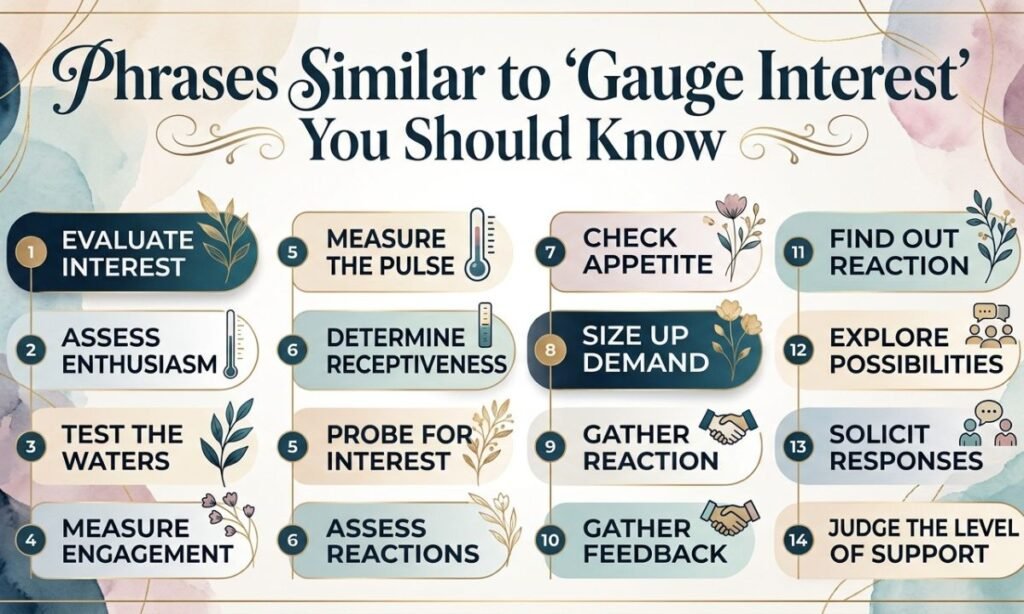
English offers a few alternative ways to express the same general idea, each with a slightly different tone:
- Assess interest — a more formal, analytical alternative common in reports and research.
- Test the waters — a casual, idiomatic way to describe checking reactions before committing.
- Sound out — often used when discreetly checking someone’s opinion before a bigger conversation.
- Take the temperature — a conversational way to describe checking general sentiment.
- Feel out — an informal phrase meaning to explore reactions carefully before proceeding.
These alternatives work well when you want to vary your language while keeping the same underlying meaning.
When Should You NOT Gauge Interest?
As useful as this step is, it’s not always necessary or appropriate:
- When time sensitivity makes early testing impractical.
- When the decision is already finalized and unchangeable.
- When gauging interest could unintentionally leak sensitive plans too early.
- When the group being asked is too small to provide meaningful signal.
In these cases, moving forward directly, or gathering feedback after launch instead, may make more sense.
Which Phrase Should You Use in Professional Writing?
For most professional and business writing, “gauge interest” is the clearest, most widely accepted choice. It reads naturally in emails, reports, and proposals, and it avoids the ambiguity of less common variants like “gage interest,” which stems from an outdated and largely obsolete word.
If you want a slightly more formal tone, “assess interest” works well in academic or analytical writing. For a more casual, conversational tone, “test the waters” fits naturally. But when in doubt, “gauge interest” remains the safest, most broadly understood option across contexts.
Frequently Asked Questions
Is “gauge interest” one word or two?
It’s two separate words, “gauge” and “interest,” used together as a verb phrase.
Can “gauge interest” be used in casual conversation?
Yes, it works well in both casual and professional settings without sounding out of place.
What is the difference between “gauge interest” and “generate interest”?
Gauging interest measures existing enthusiasm, while generating interest means actively creating new enthusiasm.
Is “gauge interest” a formal or informal phrase?
It’s flexible enough to fit both formal business writing and everyday conversation.
Can I use “gauge interest” in business emails?
Yes, it’s a professional, widely accepted phrase commonly used in workplace and marketing communication.
The Final Word
Gauge interest is a simple phrase with a practical purpose: it helps you measure enthusiasm before making a bigger move. Whether you’re launching a product, planning an event, or testing a new idea with colleagues, using this expression shows that you’re making informed decisions instead of relying on assumptions. Understanding its meaning, proper usage, and similar expressions can strengthen your communication skills and help you write with greater clarity and confidence.

I am a dedicated writer with over 3 years of experience researching word meanings, internet slang, abbreviations, and symbols. Through MeaningBright.com, I simplify complex meanings into clear, accurate, and easy-to-understand explanations, helping readers stay informed with reliable and engaging content.